Your cart is empty
Explore our collectionsCoupons
Order Summary
Total₹ 0

Navratri is one of those festivals that changes the entire feel of a home. Diyas are lit every evening, the sound of dhol fills the air, and each day is dedicated to a different form of Maa Durga. But one thing that truly makes this festival special is the flowers for Navratri offered during the puja – they aren’t just decoration; each flower carries a deep meaning connected to the goddess of that particular day.
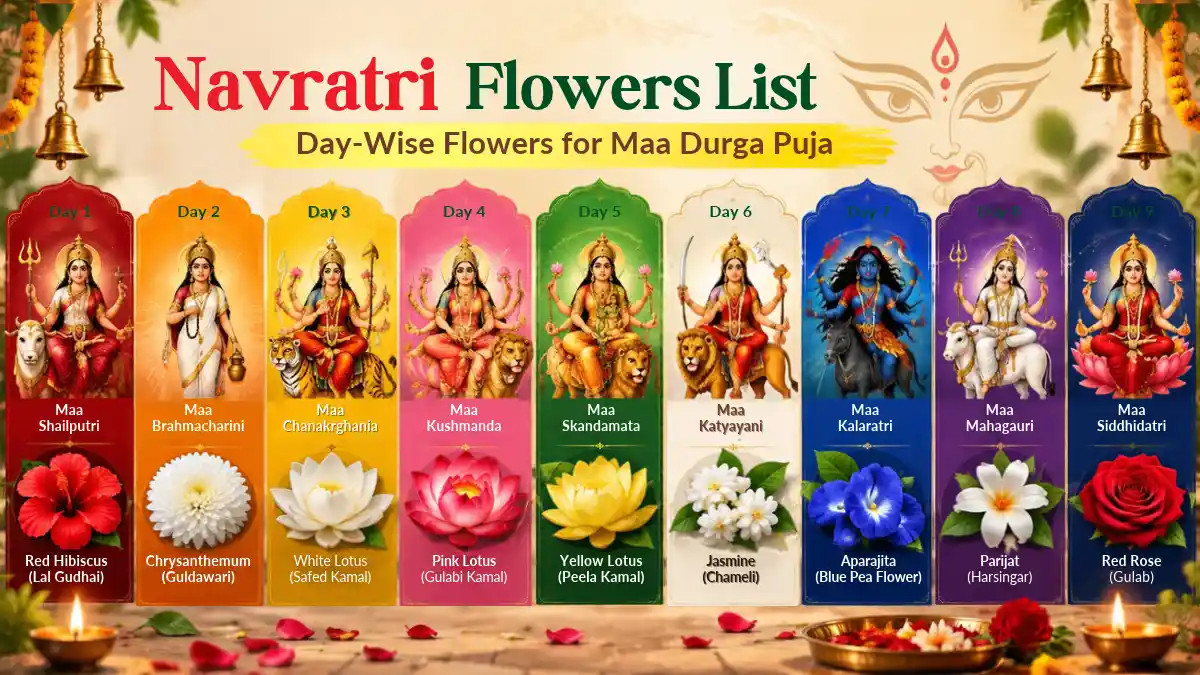
If you’ve ever wondered which day-wise flowers for Navratri you should offer, this guide is for you. We’ll walk through the complete Navratri flowers list, their Hindi names, botanical names, and most importantly, why each flower is chosen for that specific day.
In this table, there is a complete 9-day Navratri flowers table so you can see everything at a glance.
| Day | Goddess | Flowers | Symbolism |
| Day 1 | Maa Shailputri | Hibiscus | Shakti, devotion, vitality |
| Day 2 | Maa Brahmacharini | Jasmine / White Chrysanthemum | Purity, peace, devotion |
| Day 3 | Maa Chandraghanta | Lotus | Auspiciousness, positivity, joy |
| Day 4 | Maa Kushmanda | Jasmine \ Mogra | Purity, simplicity, freshness |
| Day 5 | Maa Skandamata | Yellow Rose \ Marigold | Warmth, auspiciousness, devotion |
| Day 6 | Maa Katyayani | Marigold \ Red Rose | Love, devotion, strength |
| Day 7 | Maa Kalaratri | Night-Blooming Jasmine \ Passiflora | Fragrance, beauty, devotion |
| Day 8 | Maa Mahagauri | Mogra \ White Lily | Purity, peace, serenity |
| Day 9 | Maa Siddhidatri | Plumeria Alba or Champa | Grace, beauty, spiritual devotion |
Now let’s go day by day and understand which flower is offered to which day of Navratri, and the reasoning behind it.
Hindi name: गुड़हल (Gudhal)
Botanical Name: Hibiscus rosa-sinensis
When it comes to day 1, the first day of Navratri is dedicated to Maa Shailputri, daughter of the Himalayas. On this day, the hibiscus plant for puja is traditionally used.
Hibiscus is a bold, vibrant flower that represents strength and vitality – much like Maa Shailputri herself, who is considered the first form of Shakti. Its deep red colour reflects courage and energy, which is why it’s considered the most appropriate flower for the opening day of the festival.
Hindi name: चमेली / सफेद गुलदाउदी (Chameli / Safed Guldaudi)
Botanical Name: Jasminum officinale / Chrysanthemum morifolium
On the second day, Maa Brahmacharini, the goddess of penance and sacrifice, is worshipped. Jasmine or White Chrysanthemum is offered to her.
If we talk about the 2nd day of Navratri, both chrysanthemum and jasmine symbolize purity and peace during Navratri. As we all know, Maa Brahmacharini represents simplicity and devotion; these white, fragrant flowers align perfectly with her nature.
Hindi name: कमल (Kamal)
Botanical Name: Nelumbo nucifera
The third day belongs to Maa Chandraghanta, recognized by the crescent moon on her forehead, shaped like a bell. The lotus is the flower offered on this day.
The lotus has always been a symbol of auspiciousness and positivity. The lotus grows in muddy water; it stays pure – a quality that reflects both the strength and serenity of Maa Chandraghanta.
Hindi name: मोगरा (Mogra)
Botanical Name: Jasminum sambac
On the fourth day, Maa Kushmanda is worshipped – the goddess believed to have created the universe with her smile. Jasmine or mogra plant for pooja is used on this day.
Mogra’s light, sweet fragrance represents freshness and simplicity, echoing Maa Kushmanda’s role in the gentle yet powerful act of creation.
Hindi name: पीला गुलाब / गेंदा (Peela Gulab / Genda)
Botanical Name: Rosa (yellow variety) / Tagetes erecta
The fifth day is dedicated to Maa Skandamata; the Yellow Rose or Marigold is offered in this day.
The yellow rose symbolizes warmth and auspiciousness. Marigold is also widely used here, and interestingly, a marigold plant online search is one of the most common ones during Navratri season since it’s so easy to source and grow.
Hindi name: गेंदा / लाल गुलाब (Genda / Laal Gulab)
Botanical Name: Tagetes erecta / Rosa
The sixth day is dedicated to Maa Katyayani, the fierce and powerful form of the goddess. Marigold or Red Rose is offered on this day.
Marigold’s bright orange-yellow shade represents love and devotion, and if we talk about the red rose, the red rose signifies strength – both qualities associated with Maa Katyayani’s protective and courageous nature.
Hindi name: रात की रानी / कृष्ण कमल (Night-Blooming Jasmine / Krishna Kamal)
Botanical Name: Cestrum nocturnum / Passiflora incarnata
On the seventh day, Maa Kalratri, the destroyer of evil, is worshipped. Night-Blooming Jasmine or Passiflora is offered on this day.
As we all know, the name night-blooming jasmine, this flower blooms at nights and this flower spreading its fragrance through the darkness and the flower beautifully combines beauty with devotion.
Hindi name: मोगरा / सफेद लिली (Mogra / White Lily)
Botanical Name: Jasminum sambac / Lilium candidum
The eighth day belongs to Maa Mahagauri, the goddess of peace and purity. And if we talk about the flowers for this day, Maa Mahagauri likes Mogra or White Lily. White flowers represent serenity and calm, mirroring Maa Mahagauri’s fair, peaceful form.
Hindi name: चंपा (Champa)
Botanical Name: Plumeria alba
On the final day, Maa Siddhidatri – the giver of all siddhis – is worshipped. On this day, Plumeria alba, or Champa, is offered to Maa, and people pray on this day.
Champa’s soft petals and sweet fragrance represent grace and spiritual devotion – a perfect closing note to this nine-day spiritual journey.
If you noticed one thing during Navratri, it’s that these flowers are easily available during this time. All these flowers are considered the most traditional flowers used in Navratri puja because of their availability, fragrance, and spiritual symbolism. Understanding the Navratri puja flowers’ meaning and significance helps you connect more deeply with each day’s ritual instead of just following it mechanically.
Now that you know the full list of flowers for each form of Maa Durga, here are a few practical tips to help you manage these flowers at home.
A few things worth checking before you pick your flowers:
Keeping flowers fresh before and after puja is its own small skill:
Absolutely! More people today prefer growing their own puja flowers at home. Here are some of the best flowers you can grow for Navratri at home:
Hibiscus – grows easily in a garden or even a balcony pot because it needs moderate sunlight and regular watering.
Marigold – the easiest puja flower to grow, blooming almost throughout the year.
Mogra – a fragrant, compact plant that does well in pots.
Chrysanthemum – needs a bit more patience but can also work as one of the indoor plants if given the right light. A quick look at chrysanthemum plant listings shows how popular it’s become for home gardens in India.
Champa (Plumeria) – a small tree, perfect for a balcony or terrace garden, that flowers year after year.
Parijat – if you can find a parijat plant online, it’s worth growing too; its fragrant white-and-orange flowers are considered sacred and are often used in various pujas beyond Navratri.
Rose – a good rose plant for puja flowers gives you both yellow and red blooms across the festival days.
If you’re specifically looking at indoor plants in the flowering category, mogra and chrysanthemum are both good options since they tolerate bright indirect light reasonably well.
Navratri is really more than just a festival – it’s nine days of devotion, where every day brings its own form, its own color, and its own flower for Maa Durga. If you end up buy flowers online or from the market or growing them at home, what really matters is that the flowers are fresh and the intention behind them is genuine.
Hope this guide makes it a little easier to pick the right flower for each day and adds a bit more meaning to your puja this year. Jai Mata Di!!!!!
1. Can Marigold Be Used Every Day of Navratri?
Yes, you can use marigold every day of Navratri. Fresh yellow or orange marigolds are commonly used for puja and are considered auspicious.
2. What Flowers Should Not Be Used for Puja?
Avoid using flowers that are dry, wilted, damaged, or dirty. Fresh and clean flowers are always a better choice for puja.
3. Which Flower Is Commonly Offered to Maa Durga?
Red hibiscus is traditionally offered to Maa Durga in many places. However, traditions can vary by family and region.
4. Do the Flowers Differ by Region?
Yes, flowers used for Navratri puja can differ by region. Local traditions and the availability of flowers often influence the choice.
5. Is It Necessary to Use a Different Flower Each Day?
No, it is not necessary. You can use available fresh flowers and follow your family or local puja traditions.